
Hon. Alex Mascot Ikwechegh, the outspoken member representing Aba North/Aba South Federal Constituency in the House of Representatives, has officially joined the Labour Party, ending weeks of political speculation and reported pressure from the All Progressives Congress (APC).
Ward Registration in Aba Marks Formal Entry
Ikwechegh completed his formal registration at Industrial Ward 2 in Aba North on Wednesday afternoon, fulfilling the mandatory ward-level process required for party membership. The move was described by supporters as a symbolic return to his grassroots base in Aba.
Popularly known as “Onyeocha na Aba,” the lawmaker was accompanied by loyalists, many of whom had earlier resigned en masse from the All Progressives Grand Alliance (APGA). The mass resignation significantly altered the political structure in Aba North and Aba South, two key commercial centers in Abia State.
Reception at Government House, Umuahia
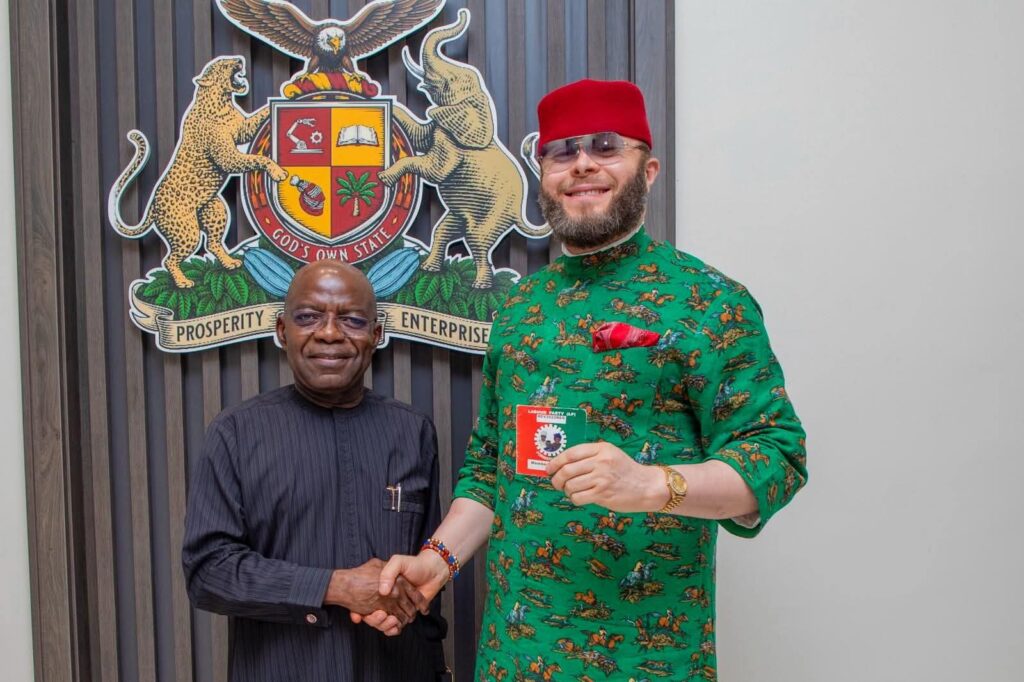
Following his ward registration, Ikwechegh proceeded to the Government House in Umuahia, where he was formally received by Abia State Governor Alex Otti. Also present was Hon. Ginger Onwusibe, the member representing Isiala Ngwa North/Isiala Ngwa South Federal Constituency.
The reception signaled the Labour Party’s official acceptance of the federal lawmaker into its ranks and underscored what party insiders described as a strategic political realignment ahead of future electoral cycles.
Decision Despite Alleged APC Pressure
Sources close to the development claimed that Ikwechegh faced intense lobbying efforts from APC figures, including reported meetings with President Bola Tinubu and offers from party stakeholders. However, the lawmaker chose to align with the Labour Party in Abia State.
Speaking at the event, Ikwechegh cited governance performance as a key factor in his decision.
“I have watched what Governor Otti is doing in Abia—in infrastructure, education, healthcare. When you see leadership delivering results, you don’t fight it; you support it,” he said.
He added that his primary concern remained effective representation for his constituents in Aba North and Aba South.
Political Tensions Following Budget Oversight Clash
Ikwechegh’s defection follows a week of heightened national attention surrounding his participation in a House Appropriation Committee session. During the hearing, he questioned Finance Minister Wale Edun over the status of ₦1.15 trillion reportedly approved for capital projects but allegedly yet to be disbursed.
The following day, Minister of State for Finance Doris Uzoka-Anite appeared before the committee to address related concerns. She acknowledged that although funds were approved, certain pre-disbursement conditions had not been met.
Days later, the Presidency announced a cabinet reshuffle in which Uzoka-Anite was removed as Minister of State for Finance. While no official link was drawn between the budget hearing and the reshuffle, political observers have noted the timing of events.
Grassroots Realignment in Aba
In the days preceding his formal defection, more than 90 ward and local government officials loyal to Ikwechegh reportedly resigned from APGA structures in Aba North and Aba South. His own resignation from APGA followed shortly afterward.
Analysts say the development could significantly reshape political dynamics in Abia State, particularly in Aba, widely regarded as the state’s commercial nerve center.
Implications for Abia Politics
Ikwechegh’s move strengthens the Labour Party’s representation in Abia and aligns him more closely with Governor Otti’s administration. Observers suggest that the collaboration between a federal lawmaker and a state governor from the same political platform could potentially influence project facilitation, legislative advocacy, and intergovernmental cooperation.
For constituents in Aba North and Aba South, the development represents both a political shift and a consolidation of leadership within the Labour Party structure in Abia.
As political alignments continue to evolve ahead of future elections, Ikwechegh’s defection stands out as one of the most significant party switches in the state in recent months, underscoring ongoing realignments within Nigeria’s broader political landscape.