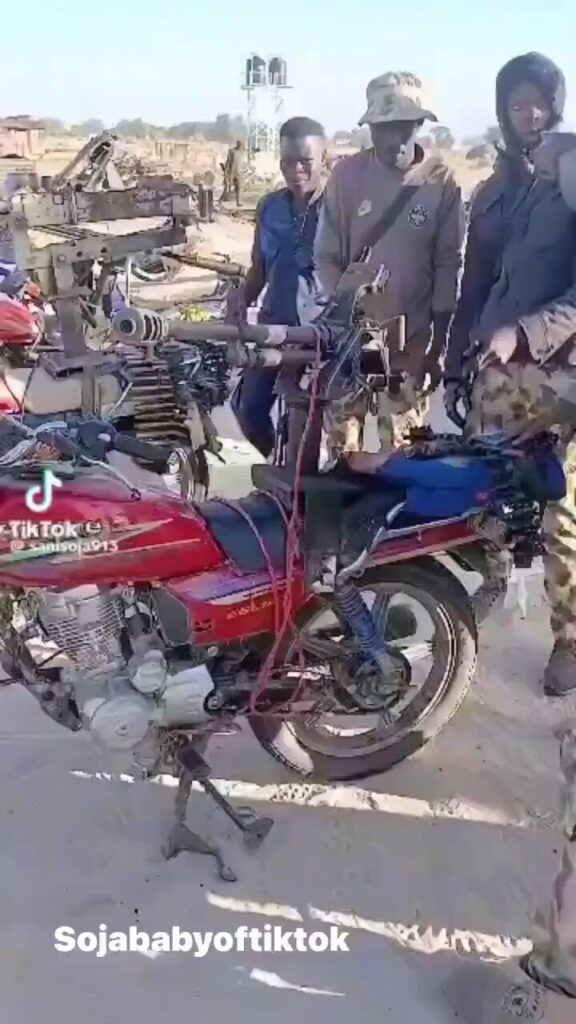

A potential tragedy was reportedly averted after troops of the Nigerian Army intercepted suspected members of the Islamic State West Africa Province (ISWAP) allegedly moving with mounted weapons in a coordinated operation.
Security sources disclosed that the suspects were apprehended while transporting heavy firearms mounted on vehicles, commonly referred to as “gun trucks,” raising fears that they may have been heading toward Jos or nearby communities. Although military authorities are yet to release full operational details, preliminary reports suggest the interception followed actionable intelligence and surveillance.
The development has once again drawn attention to the growing sophistication of weapons used by terrorist groups operating in Nigeria. Observers have questioned how non-state actors continue to access advanced weaponry, including anti-aircraft guns, rocket-propelled grenades, and armored vehicles. Security analysts often attribute this to arms trafficking networks across the Sahel region, porous borders, and the spillover of weapons from conflicts in countries like Libya.
ISWAP, a faction that broke away from Boko Haram, has remained active in parts of the North-East, particularly around Lake Chad. While Boko Haram gained global notoriety for mass abductions, suicide bombings, and attacks on civilian populations, ISWAP has focused more on targeting military formations and consolidating territorial influence in rural communities.
Beyond insurgency in the North-East, Nigeria has also faced a persistent threat from heavily armed bandit groups operating across the North-West and parts of the North-Central region. These bandits have been responsible for mass kidnappings of schoolchildren, attacks on farming communities, and large-scale cattle rustling. In many instances, they deploy motorcycles in large numbers to raid villages, overwhelming local security presence before retreating into forests.
Jos and surrounding areas in Plateau State have previously experienced security challenges linked to communal tensions and sporadic armed attacks. The reported interception of suspected ISWAP fighters has therefore heightened concerns about possible expansion of extremist activities beyond their traditional strongholds.
The Nigerian military has in recent years intensified counter-terrorism operations, conducting airstrikes on insurgent enclaves and dismantling camps across several states. Joint operations involving regional forces under the Multinational Joint Task Force have also targeted extremist supply routes around the Lake Chad Basin.
While the recent interception is being seen as a major breakthrough, experts stress the need for sustained intelligence gathering, improved border security, and community-based vigilance to curb the spread of terrorism and armed banditry in Nigeria.